
How to Check Criminal History in Bremer County
Start with the record that can answer the question. Iowa Courts Online is the free public route to a Bremer County criminal case docket. Search by an exact case number when possible, or use the party name and narrow the county and case type. The docket can show filed counts, hearings, status, disposition, sentence, and financial entries. It is an index of court activity. Public documents that do not appear remotely can be viewed at a courthouse terminal or requested from the Clerk of District Court.
Current custody needs a separate check. Bremer County routes jail searches to VINELink, with jail option 2 as the phone fallback for a fresh or unclear result. The Iowa Department of Corrections covers people who have moved into state custody or supervision. The DCI Support Operations Bureau maintains the central repository, while its record-check channel releases eligible Iowa history. A local incident narrative still comes from the arresting agency.
- Search the Bremer County court docket by exact case number or carefully spelled name.
- Check VINELink and call the jail when present custody is the main issue.
- Use Iowa Offender Search after a sentence or transfer to state custody.
- Request the report from the sheriff, Waverly Police, Sumner Police, Denver, or the relevant state agency.
- Order a DCI check when a statewide Iowa history is needed, then compare its result with the case disposition.
Bremer Criminal Records at Two Addresses
Two Waverly buildings hold different parts of Bremer County criminal history. The Bremer County Courthouse at 415 E. Bremer Avenue contains the Clerk of District Court, the counter for docket files, copies, courthouse-terminal viewing, and expungement filings in local cases. The Bremer County Sheriff and jail share 111 4th Street NE with Waverly Police. That public-safety building handles sheriff reports, booking questions, jail information, fingerprints, and operational warrant questions.
The split matters. The sheriff cannot provide a full court docket, and the clerk does not keep an officer’s investigative narrative. A city citation may also move from a police records system into Iowa District Court. The official county homepage shows the courthouse contact block and department route.

The county page illustrates why the courthouse is the right first stop for Bremer criminal court files, but not for a police or jail record.
Clerk of District Court
415 E. Bremer Ave.
Waverly, IA 50677
319-352-5661
Sheriff and Jail
111 4th St. NE
Waverly, IA 50677
319-352-5400
Official Iowa Background Checks
The Iowa Department of Public Safety, Division of Criminal Investigation, keeps the central criminal-history repository. Anyone may request a name-based Iowa check. The required identifiers are first name, last name, and exact date of birth. Middle name, gender, and Social Security number can help distinguish a common name, but they are not the minimum required fields. DCI accepts requests online, by mail, fax, email, and in person. It does not accept record-check requests by phone.
Each last name costs $15 to search. A surname change or alias can therefore require a separate paid request. A subject release also changes what DCI may disclose. It can permit release of a successfully discharged deferred judgment or an arrest older than 18 months that lacks a reported disposition. For the subject’s own federal history, the FBI Identity History Summary is a separate fingerprint-based process. Local law enforcement supplies fingerprint-card service, and the Bremer Sheriff phone menu routes fingerprint questions to jail option 2.
The official DCI criminal-history page lays out the Iowa request paths and fees.
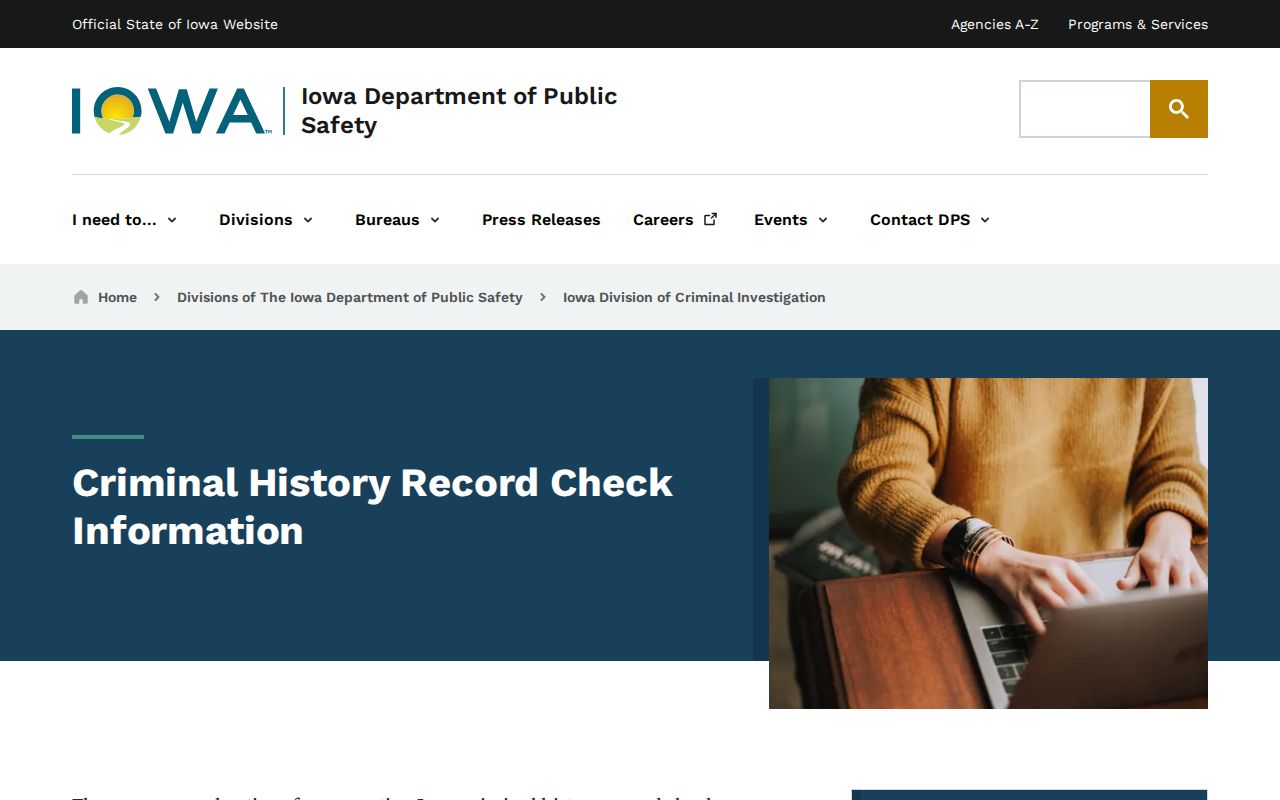
This state channel adds releasable fingerprint-supported history, but it is not a substitute for every Bremer court file, police report, or jail entry.
| DCI request field | Use | Required |
|---|---|---|
| Last name | One $15 search per surname | Yes |
| First name | Exact subject identifier | Yes |
| Date of birth | Exact date needed for the search | Yes |
| Middle name and gender | Help resolve close matches | No |
| Subject signature | Affects access to restricted data | Conditional |
| Requester and delivery details | Direct the completed response | Yes |
Bremer Sheriff Criminal Records Requests
The Sheriff’s Civil/Records Division is the direct fallback for records created by the Bremer County Sheriff. A useful written request names the record type, incident date and time, location, report or case number, desired format, and a date range. Email sheriff@co.bremer.ia.us, send mail or visit 111 4th Street NE, or fax 319-352-0233. Phone option 5 helps identify the right custodian. Jail and inmate questions use option 2.
No dedicated online order form, fixed turnaround, or broad identification rule was verified. Ask for an estimate before approving significant search or redaction costs. Iowa law allows reasonable actual expenses, while directing custodians to try to provide records without charge beyond copying when production takes less than 30 minutes. A denial or delay can be followed by a written request for the legal ground and guidance from the Iowa Public Information Board.
The Civil/Records Division page identifies the local file inventory and published fees.
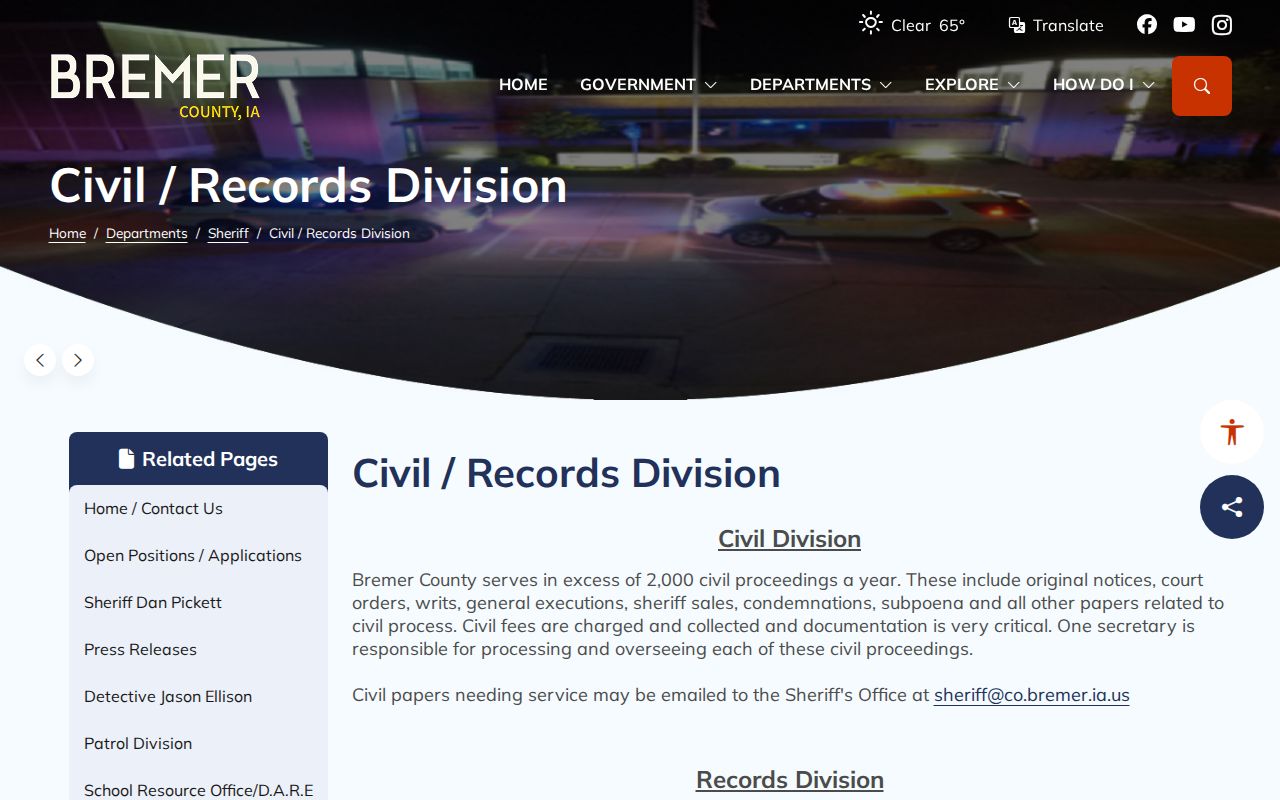
The division keeps patrol, investigation, and jail records, so a precise product name is more useful than a broad request for a full history.
| Bremer Sheriff product | Published fee |
|---|---|
| Accident report | $10 |
| Incident report | $10 |
| Local criminal-record product | $15 |
| Driving record | $15 |
| Fingerprinting | $5 |
| Photograph or video/audio copies | $25 each |
Types of Criminal Records
Bremer County criminal records are not one file. Each custodian creates a record for a different event and purpose. The police narrative can exist without an arrest. Booking proves custody at a point in time, not guilt. Prosecutors may file charges that differ from the arrest allegations, and the court later records the actual outcome. DCI can miss an arrest if qualifying fingerprints were not submitted or matched.
- Incident or arrest report: The arresting agency records the response, immediate facts, and investigative work, subject to lawful redaction.
- Booking record: The jail records intake, custody, charges at entry, bond, and release data.
- Court case file: Iowa District Court records filed charges, motions, hearings, pleas, judgment, sentence, and costs.
- DCI history: The state compiles releasable, fingerprint-supported arrest cycles and reported outcomes.
- Corrections or registry record: Iowa DOC and the Iowa Sex Offender Registry publish the fields state law allows.
Iowa District Court hears Bremer felonies and misdemeanors. Felony classes run A through D; misdemeanors are aggravated, serious, or simple. Class labels affect possible punishment, but offense-specific rules can change a sentence. A warrant remains distinct: a judicial officer issues it, while courts and law enforcement maintain its status. No verified public active-warrant database exists, so confirm a current warrant by phone and case number.
Bremer Criminal Records After Booking
The Bremer County jail can house up to 79 inmates and also holds some prisoners for other counties and the federal government. Yet the county does not publish its own roster or mugshot gallery. Its official jail page sends searchers to VINELink for custody status and notifications. A name that is absent there does not prove no arrest. Intake, release, and transfer timing can change quickly, so jail option 2 is the practical fallback for recent or uncertain custody.
Once a person transfers to state custody or supervision, switch to Iowa Offender Search. For permitted details that do not appear there, Iowa DOC accepts an open-record request. Court status still belongs in Iowa Courts Online. This chain separates a short county stay, a filed case, and a state sentence rather than treating them as one record.
Bremer criminal record flow often reads: arresting agency → jail booking → DCI fingerprint cycle → prosecutor review → Iowa District Court disposition → county or state custody and supervision.
Note: VINELink reports custody events and notifications; it does not establish guilt or replace the final disposition entered by Iowa District Court.
What a Bremer County Criminal Record Shows
The contents depend on the source. A DCI response groups identifiers, fingerprint-backed arrest cycles, reported dispositions, and some correctional movements. An Iowa Courts Online entry follows one court case. Jail data focus on intake and custody. Public copies can omit Social Security numbers, protected victim or minor information, and other confidential identifiers. Match the field to its source before drawing a conclusion.
| Name and identifiers | Name, aliases, birth information, sex, and state or FBI identifiers where release is authorized. |
|---|---|
| Arrest and booking | Date, agency, charges at intake, booking or custody data, bond, and release information when public. |
| Charges and statutes | Each alleged offense, its Iowa Code reference, class, and changes made after prosecutor review. |
| Disposition | Pending, dismissed, acquitted, convicted, or deferred judgment for each separate count. |
| Sentence | Jail or prison term, probation, restitution, fines, and other court orders shown in the case. |
| Custody or supervision | Public jail, prison, probation, or parole status and the responsible agency. |
Read every count. One count may be dismissed while another ends in a conviction. A “no Iowa criminal history found” DCI response also needs care because it can reflect no file, restricted information, or juvenile information that cannot be released.
For correctional details beyond the docket, the Iowa DOC open-records request page identifies the formal state-record fallback.
That route can clarify releasable custody or supervision fields without confusing a state corrections record with a county booking entry.
Bremer Probation and Parole Records
Bremer County lies in Iowa Judicial District 2. Probation and parole supervision operate through the state and judicial-district corrections framework, while the Iowa Board of Parole makes release decisions. Parole officers are not Board employees. Begin with Iowa Offender Search, then use the court docket for a probation sentence or revocation filing. Confirm the currently assigned local field office with Iowa DOC because older directories can lag behind agency changes.
Iowa law allows specified public correctional fields, including name, age, sex, status as an inmate, parolee, or probationer, non-home-street location, supervision term, supervised offenses, commitment county, physical description, and service type. If the locator lacks a permitted field, DOC’s request channel is the fallback.
The Iowa Board of Parole overview explains the Board’s role in release decisions. Its official parole FAQs distinguish Board review from supervision, while the victim notification channel explains the separate registration route.
The Board layer should be read beside the Bremer court judgment and DOC status, not as a stand-alone criminal history.
Public Access Laws
Iowa Code chapter 22 gives people a right to examine and copy public records unless another law makes the material confidential. The rule does not open every line of a police file. Investigative reports may be protected, but the date, time, specific location, and immediate facts and circumstances generally remain available unless release would seriously jeopardize an investigation or create a clear danger. Chapter 692 separately controls named-person criminal-history dissemination and gives a subject or attorney rights to inspect, copy, and challenge the subject’s own state record.
Key Iowa laws:
Iowa Code §§22.2 and 22.3 grant access and permit reasonable actual production costs.
Iowa Code §22.7(5) and (9) protect investigative and intelligence material while preserving access to defined public facts.
Iowa Code §§692.2 through 692.5 govern dissemination, restricted information, subject inspection, and correction challenges.
Iowa Code chapter 901C makes qualifying records confidential through expungement.
Narrowing a request by date, location, record type, and case number can reduce search and redaction work. If a record is withheld, ask the custodian to identify the legal basis in writing. The Iowa Public Information Board provides chapter 22 guidance and a complaint route.
Bremer DCI Criminal Record Gaps
A DCI response saying no Iowa criminal history was found is not an absolute statement that no law-enforcement contact occurred. DCI gives three possible meanings: no matching history is on file, matching information exists but is not releasable without authorization, or juvenile information is restricted. An arrest can also fail to enter the central repository when qualifying fingerprints were never submitted.
If the result appears to belong to someone else or omits a known event, compare the exact name and birth date, the court case, and the arresting agency’s record. The subject may send DCI detailed disputed information, and DCI may request fingerprints. Iowa Code §692.5 gives the subject or attorney a right to inspect, copy, and file a written challenge. DCI must decide that challenge within 20 days, with review available under state administrative law.
- Arrest cycle
- A fingerprint-supported arrest event linked with later disposition data in the state repository.
- Disposition
- The outcome of a charge, such as dismissal, acquittal, conviction, or deferred judgment.
- Deferred judgment
- An Iowa process that postpones judgment while conditions are completed; successful discharge restricts dissemination.
- Challenge
- The subject’s written process for asking DCI to correct inaccurate or incomplete state history.
Sealed, Expunged & Restricted
Bremer County criminal records can disappear from ordinary public access for several reasons. Juvenile records are confidential. Investigative material, victim information, personal identifiers, and some medical or safety data can be withheld. A successfully discharged deferred judgment is restricted in ordinary DCI dissemination. So is an arrest older than 18 months with no reported disposition, unless the requester fits an authorized category or holds the subject’s release.
Iowa expungement makes a qualifying record confidential rather than promising physical destruction in every institutional system. Under Iowa Code §901C.3, an eligible misdemeanor generally requires more than eight years since conviction, no pending charges, payment of court debt, and compliance with the statute’s limits. Many offenses are excluded, including OWI, sex offenses, specified assault and domestic abuse offenses, harassment, stalking, weapons offenses, and public intoxication.
File in the Iowa District Court county where the case occurred. For a Bremer case, use current Iowa Judicial Branch forms and submit them to the Bremer Clerk of District Court. The reviewed official material did not establish a current filing or certified-copy fee, so confirm both with the clerk before filing. After an order, the clerk notifies DPS and DCI acts on the statutory notice.
Bremer County Warrant Record Fallbacks
No official Bremer County active-warrant database or public statewide Iowa warrant portal was verified. A safe check starts by calling the Sheriff’s Office, then reviewing Iowa Courts Online for a related case and asking the Bremer clerk about a court-issued warrant. A city citation may require the city or court channel tied to that matter. A narrow chapter 22 request can seek public warrant information, but sealed, juvenile, or active-investigation limits may apply.
Do not rely on an old web listing before taking action. Call, record the case number, and confirm the issuing court and current status. An arrest warrant rests on probable cause. A bench warrant often follows a missed court duty. A search warrant authorizes a search of a stated place or item. Resolution may require an appearance, bond, recall order, or surrender, and clearance can take time to reach each system.
The Bremer County Sheriff’s official profile identifies the county law-enforcement office and its public phone routing.
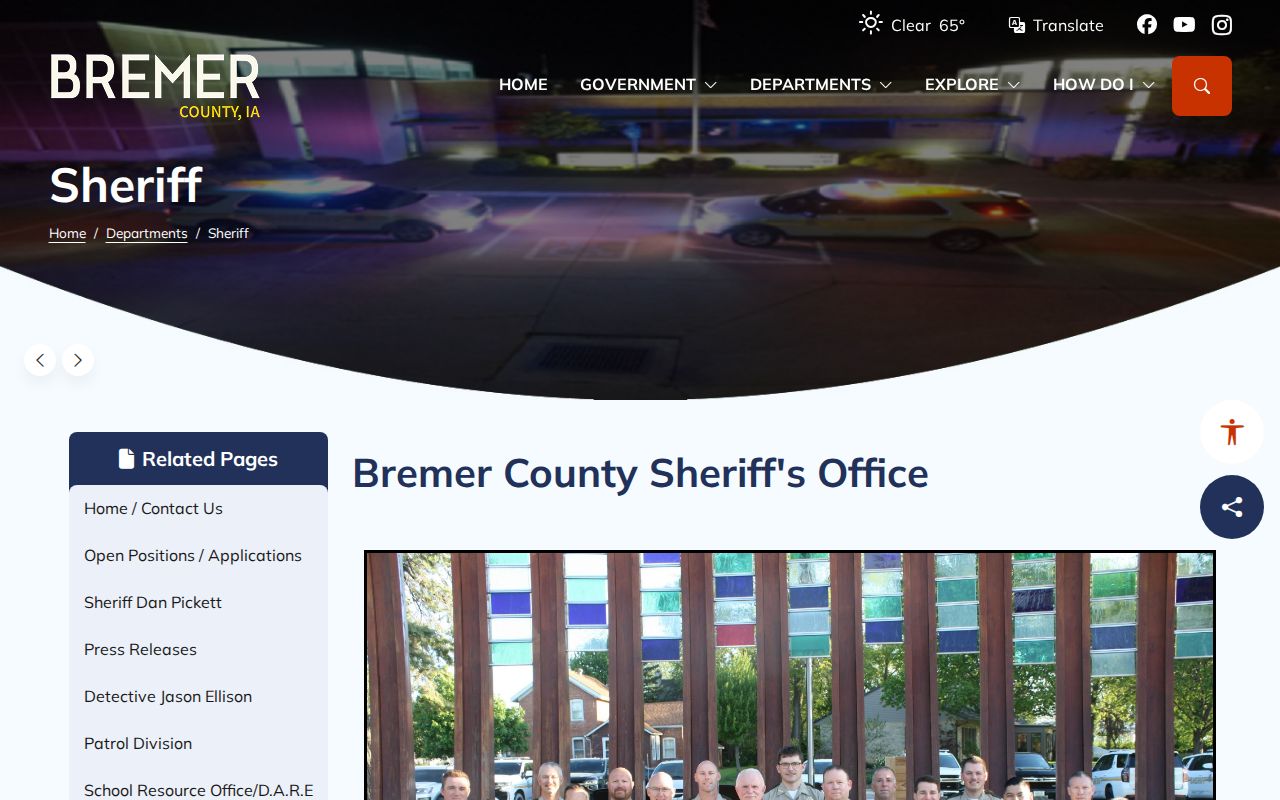
That office is the operational starting point for a current Bremer warrant question, while the clerk remains the source for the related court file.
Current status matters: For an outstanding warrant tied to you, confirm it by phone and seek legal advice before deciding where or how to appear.
Bremer Criminal Records Through Waverly
Waverly Police shows how one incident can branch into several records. Its Administrative Division keeps incident and crash reports, citations, written warnings, and parking tickets. Incident information enters TraCS and remains in the records-management system. Crash information moves electronically to Iowa DOT. Original citations go to the Bremer clerk, while a copy remains in the police system. Selected evidence may travel to DCI laboratories.
The split prevents a common error. A police report documents the city response and investigation. A booking record documents custody. The District Court docket begins when charges or a citation reach the clerk. Civil automated-traffic and parking matters should not be mislabeled as criminal history. Waverly report copies begin at a $10 minimum and may be requested by phone, at the counter, or by mailed letter and payment. The city says reports cannot be faxed.
Official combined 2020-2021 Waverly data also separate reports from arrests. For example, the agency listed 30 aggravated-assault reports and 24 arrests, while burglary showed nine reports and no arrests. Those figures are agency counts for that period, not convictions, county totals, rates, or forecasts.
Criminal Records by City in Bremer County
Bremer County’s three largest incorporated cities were Waverly, Sumner, and Denver in the 2020 Census. Their local access paths differ. Waverly publishes detailed police records procedures. Sumner provides a police nonemergency line and city written-request route, but no verified report-order portal. Denver’s gWorks FrontDesk advertises Citizen Requests, though its public pages do not establish that feature as a police-record portal. Custodial arrests from all three ultimately use Bremer County jail channels, and criminal court cases go to Iowa District Court rather than a city municipal criminal court.
Waverly Criminal History
10,394 residents in 2020 · Police records, TraCS and RMS workflow, and county-seat court routing.
Sumner Criminal History
2,030 residents in 2020 · Police phone and written chapter 22 request channels.
Denver Criminal History
1,919 residents in 2020 · City Hall and gWorks inquiry route with county court and custody fallbacks.