
How to Check Criminal History in Waverly
A Waverly record check works best when each question goes to the office that made the file. Police administration holds city incident and crash reports. Bremer County Jail holds recent custody details, while the Clerk of District Court holds the public case docket. Iowa Courts Online is the free statewide index for that docket. The Iowa Division of Criminal Investigation, or DCI, supplies a separate name-based Iowa history product. None replaces the others.
Use exact names and dates, but confirm all matches. A city report describes an event. A booking shows custody at a point in time. A court docket shows the charges filed and each result. DCI compiles releasable fingerprint-supported history reported to the state.
- Call Waverly Police administration at 319-352-5400 option 4 for the city report or its case number.
- Request a copy by phone, at the counter, or by mail, supplying the case number, incident date, and involved names when known.
- Search Iowa Courts Online by exact case number or party name, then narrow the results to Bremer County.
- Check VINELink or call the jail at option 2 when current or recent Bremer County custody is the question.
- Request the $15-per-last-name DCI check for the broader releasable Iowa history, using first name, last name, and exact birth date.
Waverly Incident Records in TraCS
The Waverly Administrative Division explains a record path that is easy to miss. Incident reports enter TraCS and remain in the department's records-management system, or RMS. Crash records also enter TraCS but transmit electronically to the Iowa Department of Transportation. Citations take another path: originals go to the Bremer Clerk, while copies remain in RMS. A single contact can therefore leave city, state transportation, and county court records.
The official Waverly police records workflow shows how the department maintains incident reports, accidents, citations, warnings, and parking tickets.
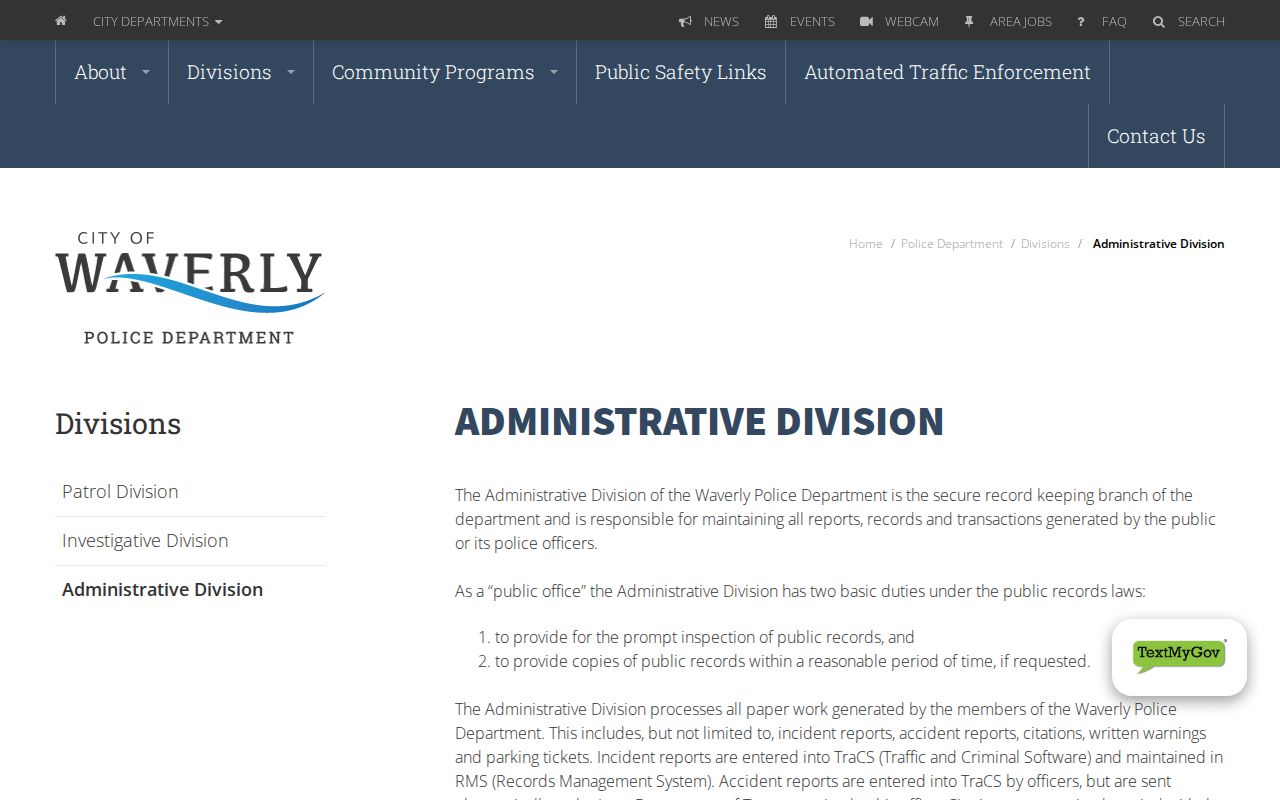
This city workflow explains why a Waverly searcher may need both the police copy and the later Bremer County docket rather than expecting one screen to contain the whole history.
The Waverly Police Department
Waverly Police administration and records share the public-safety site at 111 4th St. NE with the Bremer County Sheriff, but they are different custodians. The police mailing address is Box 616, Waverly, IA 50677. Call 319-352-5400 option 4 for administration or records. Published office hours are Monday through Friday, 7:00 a.m. to 4:00 p.m. Officers remain available around the clock, and dispatch is option 3. The web contact is not watched 24 hours a day.
That shared address can save a trip, but it does not merge the files. Ask Waverly Police for a city incident. Ask Sheriff's Records for a sheriff investigation. Ask the clerk for a court disposition. The official Waverly Police contact page provides the department's phone tree and contact route.
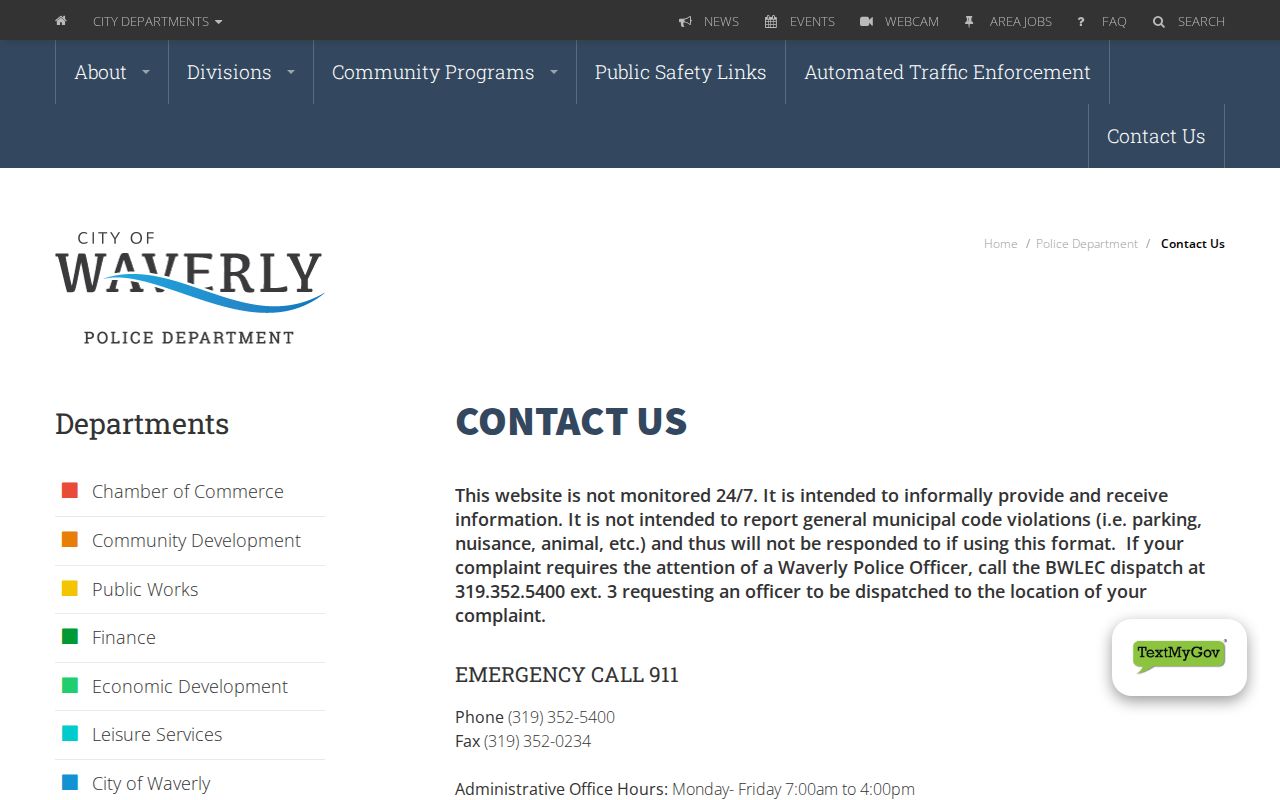
The page is useful for reaching staff, but its form is a general contact form rather than a dedicated report-order portal.
Ordering a Waverly Police Report
Waverly offers three verified copy channels: call police records, visit the counter during administrative hours, or mail a letter. The minimum charge is $10, payable to Waverly Police Department. A mailed request should include a $10 check. Give the case number, incident date, and involved names when known. Those details help staff locate the right file and separate similar names.
Reports cannot be delivered by fax. That rule matters even though the department publishes a fax number for other business. No official online report-order portal, fixed turnaround, added-page fee, certification fee, or requester-identification rule was found. Ask staff before paying if the request is large or needs certification. The official Waverly report request FAQ states the copy route and minimum fee.
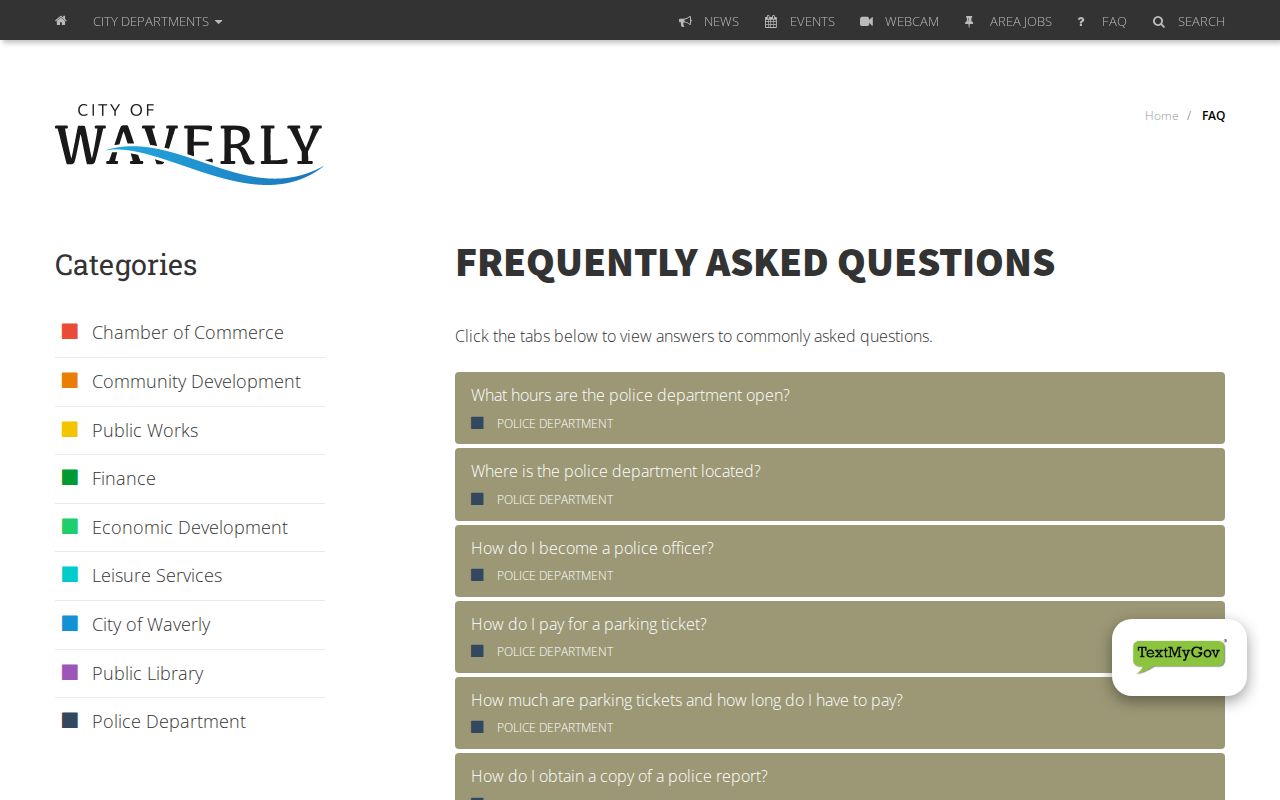
The instructions make the phone, counter, and mail choices clear, while confirming that fax is not a Waverly report delivery method.
Arrests and Bookings in Waverly
A Waverly arrest produces more than one record. The officer creates incident and arrest material. Jail intake creates custody and booking information. If fingerprints are submitted, DCI can open or match an arrest cycle. The County Attorney may then file charges that differ from the arrest charge, and Iowa District Court records the case outcome.
Bremer County does not publish its own daily roster or public mugshot gallery. Its jail page routes custody searches to VINELink. For a very recent or unclear result, call 319-352-5400 option 2. Sheriff's press releases can provide official incident summaries, but they are not a complete arrest history. If a person later enters state custody or supervision, use Iowa Offender Search. The broader Bremer County arrest history explains those county and state custody channels in depth.
Reading Waverly Police Record Counts
Waverly's official 2020-2021 UCR report separates reports from arrests. It lists 30 aggravated-assault reports and 24 arrests, 33 simple-assault reports and two arrests, nine burglary reports and no arrests, 47 shoplifting reports and 38 arrests, and 31 drug-violation reports with 27 arrests. These are combined-period agency counts. They are not conviction totals, rates, forecasts, or proof about a named person.
The distinction gives a practical lesson. A reported event does not always lead to an arrest, and an arrest does not always lead to a conviction. The official Waverly annual report library is the source channel for police reports and later updates.
Use the named report period and its separate columns whenever local totals provide context for a Waverly criminal record search.
Waverly Municipal Court Records
Waverly has no separate municipal criminal court. City citations and criminal charges go to the Bremer Clerk of District Court and Iowa District Court. Civil automated-traffic-enforcement matters and parking processes should not be mislabeled as criminal history. Search Iowa Courts Online for a filed criminal case, then use the courthouse public terminal or ask the clerk for public documents that are not shown remotely.
| Court Name | Iowa District Court for Bremer County, not a Waverly municipal criminal court |
|---|---|
| Case Types Heard | Filed felonies, misdemeanors, and qualifying city citations; civil municipal infractions remain distinct |
| Case Lookup Channel | Free Iowa Courts Online docket, clerk counter, courthouse terminal, and copy request |
| What the Docket Shows | Case number, charges, events, hearings, status, disposition, judgment, sentence, and financial entries |
| Copies & Fees | Ask the Bremer Clerk at 319-352-5661; an exact local copy fee was not verified |
The city legal department's citation routing page points citation and District Court questions toward the county court process.
That route confirms why a Waverly city search must move to the county clerk once a matter becomes a court case.
Iowa Courts Online offers useful ways to narrow that next search. A trial-court name search needs at least two letters in the last or firm name, and a first-name initial should be entered without a period. The percent sign works as a wildcard. When an exact case number is available, enter all 17 characters and do not swap the letter O for zero. Results open through the Case ID. The docket is an index, so a Waverly searcher may still need the courthouse terminal or a clerk copy for the full public filing. Advanced Case Search and Schedule Search are subscriber tools, while the ordinary docket search remains free and needs no registration.
Waverly ATE Versus Criminal Records
Automated traffic enforcement, or ATE, can create city notices and municipal-infraction proceedings. It should not be folded into a criminal-history result merely because a citation reaches a court process. A Waverly ATE challenge follows the city's official automated-enforcement procedure, while an Iowa criminal docket reflects charges prosecuted through District Court.
Read the case type before drawing a conclusion. A parking matter, civil municipal infraction, police incident report, arrest booking, and criminal judgment are distinct records. If Iowa Courts Online returns a possible match, open the case and read each charge and disposition instead of relying on a name alone.
Waverly Evidence and DCI Records
Waverly investigators may send selected evidence to Iowa DCI laboratories for toxicology, narcotics, or DNA work. That transfer is part of an investigation, not a public statewide case file. The Waverly report remains with the police custodian, while any filed charge and disposition belong in the Bremer County court record.
A lab role can also explain why an investigative report has protected portions. Request the releasable city report from Waverly Police and the public case material from the clerk. Do not ask DCI's criminal-history unit to supply a local evidence report merely because a state laboratory helped analyze an item.
Where Waverly Records End Up
Waverly Police retains the city report and related RMS material. The Bremer County Jail separately records custody. The Bremer Clerk creates the docket after charges are filed, and the court reports qualifying disposition data through the criminal-history chain. DCI may match that outcome to a fingerprint-supported arrest cycle. Missing fingerprints, delayed reports, restricted juvenile files, expungement, or a name mismatch can leave gaps.
Record flow: Waverly Police Department › Bremer County Courts › Iowa Department of Public Safety, Division of Criminal Investigation
For fresh activity, start with Waverly Police and the jail. For the filed charge and outcome, use the clerk and Iowa Courts Online. For a broader releasable Iowa history, use DCI. A “no Iowa criminal history found” response is not proof that no police contact ever occurred.
Waverly Records Across Two Eras
Waverly police history dates local law enforcement to 1868. The city is also the county seat, home to the courthouse and the shared public-safety building. That history helps explain today's split. Court archives center on the 1937 courthouse, while police and booking files center on the later law-enforcement site. Digital systems now move citations, crashes, and evidence along different routes, but the custodian still depends on who made the record.
Wartburg College and Cedar River recreation are part of Waverly's local identity, reflected in the Census Bureau's official Waverly facts. A neighborhood or campus setting does not change the access rule. Ask the responding agency for its report, the jail for custody, and the clerk for the filed case. Investigators may also send selected evidence to DCI laboratories for toxicology, narcotics, or DNA work, which does not turn the state lab into the public source for the whole police file.
The county's physical record split also has a long history. The Bremer County comprehensive plan supplies community and historical context. The 1937 courthouse once contained a ten-person jail, but sheriff and jail operations moved to the present public-safety site in 1975. A later local-option sales-tax vote financed the modern jail and renovation. Today, older court material remains a clerk question, while inactive jail files and sheriff-created records belong with the law-enforcement custodian. That distinction remains visible in current Bremer County records.
Public Access Rules
Iowa law starts with access to public records, then protects defined confidential material. Waverly may redact victim, juvenile, medical, personal-identifier, and active-investigation details. Peace-officer investigative reports receive protection, but date, time, specific location, and immediate facts and circumstances generally cannot be withheld unless release would seriously jeopardize an investigation or create a clear danger. Narrow requests can reduce search and redaction work.
Key Statutes:
Iowa Code chapter 22 grants examination and copy rights, permits reasonable actual costs, and defines confidential exceptions.
Iowa Code chapter 692 governs criminal-history dissemination, restricted arrest data, subject inspection, challenges, and unlawful redisclosure.
Iowa Code chapter 901C makes qualifying dismissal, acquittal, and misdemeanor records confidential through expungement.
An arrest without a disposition is not proof of guilt. Verify the final result in the court docket, and ask the clerk about restricted or older material when the public index does not answer the question.